
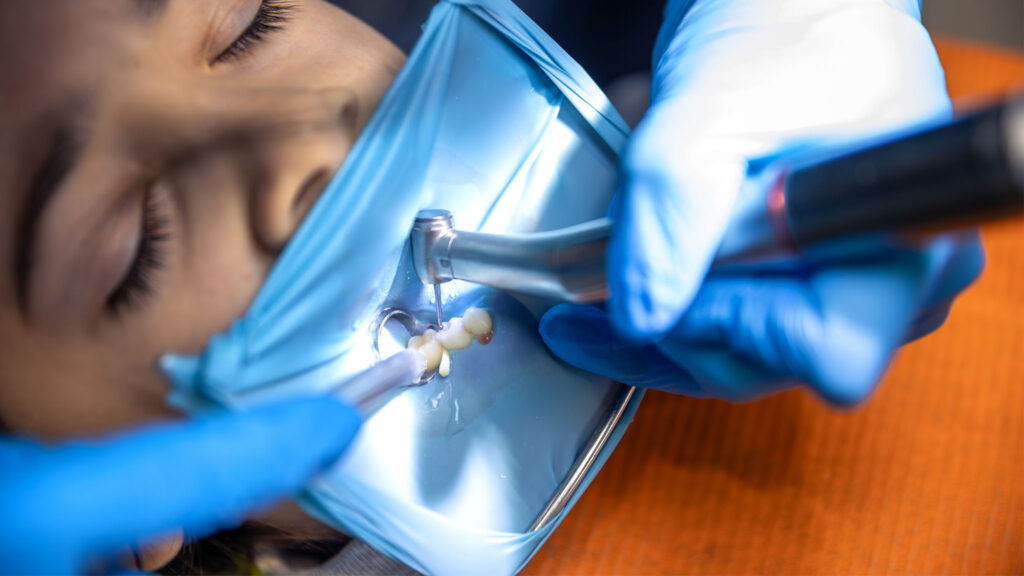
Root canal treatment, also known as endodontic treatment, may be recommended for several reasons. It is used to treat an inflamed or infected dental pulp. The pulp is soft tissue inside the tooth that contains nerves and blood vessels. When the pulp is irreversibly damaged, root canal treatment can often save the natural tooth and prevent the need for extraction.
The dental pulp lies at the centre of the tooth and plays an important role in its development and sensory function. In some cases, the protective layers of the tooth are compromised by tooth decay, trauma or extensive preparation. Then bacteria can reach the pulp and cause inflammation. Early symptoms may include sensitivity to hot or cold, pain when biting or spontaneous toothache. However, some cases develop without noticeable symptoms and may only be discovered at a later stage. In that case, sometimes the surrounding bone has also been affected.
Modern dentistry aims to preserve as much of the natural tooth as possible. That includes the living pulp whenever this can be achieved safely. Depending on the condition of the pulp, conservative or vital pulp treatment may be an appropriate alternative to root canal treatment. The most suitable approach is determined individually. After a clinical examination and, where indicated, appropriate dental X-rays.
How long does root canal treatment take?
In most cases, root canal treatment can be completed in one or several appointments. The time required depends mostly on the tooth’s anatomy and the extent of the infection. Also, whether the treatment is being carried out for the first time or it’s a retreatment case matters as well. More complex cases may require referral to an endodontist, a dentist with additional expertise in root canal treatment. Particularly important when dealing with difficult root canal anatomy or retreatment.
When is root canal treatment not necessary?
Not every painful tooth needs root canal treatment. In some cases, particularly when the damage is detected early, the pulp can be preserved using appropriate vital pulp treatment techniques. It is also important to understand that root canal treatment is not a routine prerequisite for fitting a crown or bridge. Although it may be necessary in certain circumstances, it should only be carried out when clinically indicated, rather than as a standard step in restorative treatment.
Depending on the diagnosis, treatment may focus on removing the cause of irritation while preserving the vital pulp. This can be possible in selected cases of pulp inflammation or deep tooth decay. Every tooth needs to be assessed individually, as removing healthy or potentially recoverable pulp unnecessarily can compromise the long-term preservation of the natural tooth.
Wisdom teeth also require an individual assessment. Their position, complex anatomy and accessibility can make treatment more challenging. In some cases, extraction may offer a more predictable long-term outcome than root canal treatment. The decision depends on the condition of the tooth, its function and the likely prognosis of each option.
How is a tooth restored after root canal treatment?
Once root canal treatment is complete, the tooth needs to be restored to protect it and allow it to function normally. Teeth that require root canal treatment have often already lost a considerable amount of their natural structure due to decay, previous restorations or fractures. This can make them more susceptible to fracture, particularly under heavy biting forces.
The most suitable restoration depends on how much healthy tooth structure remains and where the tooth is located. Options may include a filling, a composite core build-up or a crown to provide additional protection. A post may be needed in selected cases to help retain the core build-up, but it does not strengthen the root itself. Planning the final restoration is an important part of treatment. If planned properly it helps to protect the remaining tooth structure and support its long-term function.