Healthy gums are just as important to your smile as good-looking teeth. However, looking after them involves more than simply removing tartar. It includes prevention, the careful removal of bacterial biofilm and good daily oral hygiene.
In dentistry, the care and treatment of the gums fall within the field of periodontology. Most patients, however, know this type of treatment simply as a “scale and polish”. This is perfectly understandable, as removing tartar is an important part of maintaining healthy teeth and gums. Modern preventive care, though, offers more ways to clean the teeth thoroughly while being gentle on the surrounding tissues.
At My Dental Place, we use Guided Biofilm Therapy (GBT). It is a modern approach to professional dental cleaning that focuses on your individual needs, careful treatment and comfort throughout your appointment.
Depending on the condition of your teeth and gums, treatment may involve one or more visits. Before cleaning begins, we use special disclosing agents to make bacterial biofilm visible. This helps us identify the areas that need attention and focus treatment where it is most needed.
We aim to remove deposits as precisely as possible while being gentle on the teeth and soft tissues. Your appointment also includes practical advice on caring for your teeth at home. It includes which products are suitable for you and how to use them correctly. Healthy gums are not the result of a single visit to the dentist. They are maintained through small, daily habits tailored to your individual needs.
What is Guided Biofilm Therapy (GBT)?
If you associate a scale and polish with the prolonged sound of an ultrasonic scaler, vibrations and uncomfortable sensations, there is another approach to professional dental cleaning.
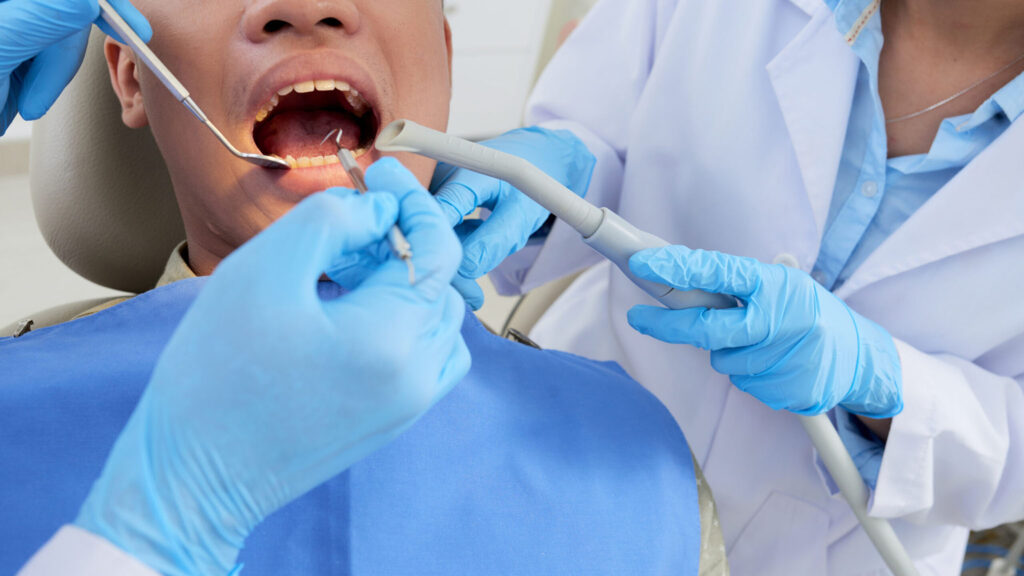
With GBT, much of the soft biofilm and surface staining can be removed using Airflow technology. It uses a controlled stream of air, water and fine powder to gently clean the tooth surfaces.
For many patients, this makes the experience more comfortable, particularly if their teeth are sensitive or conventional cleaning makes them feel uneasy. Making the biofilm visible also helps us monitor the procedure more closely and work with greater precision.
It is worth knowing that GBT is not simply a piece of equipment or another cleaning technique. It is a comprehensive protocol that combines an assessment of your oral health, biofilm disclosure, professional cleaning and practical advice on daily oral care.
What is the difference between GBT and a conventional scale and polish?
GBT and ultrasonic scaling are not competing or mutually exclusive methods. Both have an important role in professional preventive care, and the right approach depends on the condition of your teeth and gums.
Patients who have already had an initial professional cleaning and maintain good oral hygiene, deposits between routine check-ups often consist mainly of soft biofilm and surface staining. In these cases, Airflow technology can provide effective cleaning. Also offers minimal discomfort, provided it is suitable for the clinical situation.
However, when there are dense, hardened deposits, particularly in areas that are difficult to access, ultrasonic scaling remains an important part of treatment. Depending on the individual case, other suitable instruments may also be used to remove deposits safely and effectively.
That is why we do not use exactly the same method for every patient. Instead, we select the most appropriate combination of techniques for your individual needs. The aim is not simply to clean your teeth, but to make the procedure effective, precise and as comfortable as possible.
Is a scale and polish painful? Will I need local anaesthetic?
Professional dental cleaning should not be something you have to endure at all costs. However, the sensations you experience can vary depending on tooth sensitivity. The condition of your gums and the amount of tartar present matter as well.
If your gums are inflamed or your teeth are particularly sensitive, we adapt our approach to suit your needs. We work carefully and use appropriate equipment settings. If it’s necessary, carry out the treatment in stages, taking your individual sensitivity into account.
If the procedure still causes significant discomfort, local anaesthetic may be an appropriate option. You do not have to grit your teeth and put up with it. Let us know how you are feeling so that we can adjust the treatment and help you feel more comfortable.
Our aim is for you to feel relaxed, informed and in control throughout your appointment. We explain what to expect, take your individual needs into account. We also work with you in a way that establishes habits that maintain healthy teeth and gums in the long term.